
Top Signs You Need Garage Door Service – Don’t Ignore These
A door that takes 4 seconds longer to close than it did six months ago isn’t aging gracefully. The spring tension has changed, and that delay is the mechanical equivalent of a check engine light that’s been on for 180 days. Most homeowners habituate to gradual degradation, so a door that “mostly works” gets read as a door that doesn’t need service – right up until it stops working entirely. Here are the signals worth acting on, and what each one is telling you.
If you’d rather not climb up there with a ladder and a flashlight, call (877) 829-5867. We answer 24/7, with fast dispatch from 7am to 7pm, Sunday through Friday.
Key Takeaways
- Slow operation and new noise are the two earliest, most reliable warning signs.
- A balanced door should float at about waist height during a manual lift test.
- Each sound points to a different repair – grinding, popping, scraping, and rattling are not interchangeable.
- Small problems compound. A cheap adjustment left alone turns into a spring or opener replacement.
- Snapped springs, frayed cables, and off-track doors are not DIY territory.
What’s the first sign most homeowners miss?
Speed. A garage door that moves noticeably slower than it used to is the most underreported warning sign we hear about, because nothing has visibly broken yet. Springs lose tension as they cycle, and a torsion or extension spring operating below its rated load forces the opener to work harder on every single trip. That extra strain shows up first as sluggish travel, then as opener strain, and eventually as a motor that quits mid-cycle.
You can benchmark “normal” for your own door without any tools. A properly balanced door paired with a correctly sized opener should cycle open or close in roughly 10 to 15 seconds for a standard single-car door. Heavier double doors, insulated models like a Clopay or Amarr panel, and older chain-drive openers will run toward the slower end of that range – and that’s fine, as long as the door is consistent. What matters is change: if your door used to close in 11 seconds and now takes 16, the mechanics have shifted.
Don’t confuse slow speed with opener settings. Modern LiftMaster and Chamberlain myQ units have adjustable travel limits, and a door that reverses early or stops short may just need the limit re-set. But if the door is genuinely sluggish and the opener is fine, the springs are the first thing to check. Slow is not a personality trait for a garage door – it’s a symptom.
How do I test whether my springs are still doing their job?
Pull the red release handle to disconnect the opener, then lift the door by hand. A balanced door should rise easily and hold roughly at waist height when you let go. If it drops, slams down, feels extremely heavy, or shoots up on its own, the spring tension is off – and now you’ve quantified the problem instead of guessing at it.
Do this test with the door fully closed first, keep your hands clear of the hinges and panel gaps, and never stand underneath the door while it’s disconnected. If the door is already heavy, stuck, or won’t budge, stop. That’s your answer, and it means a professional needs to look at it.
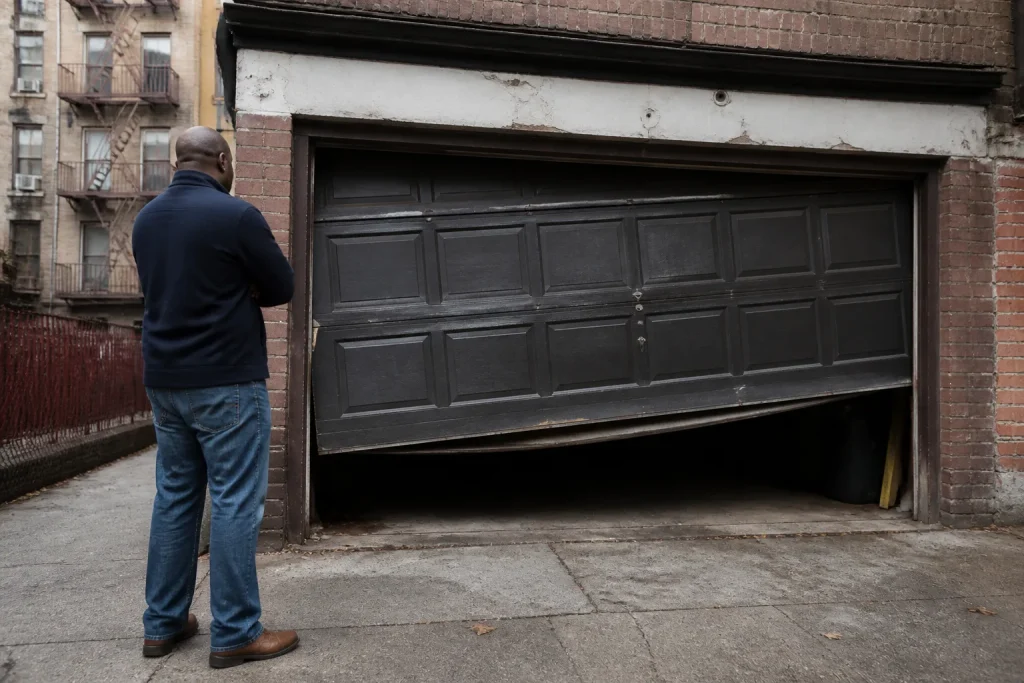
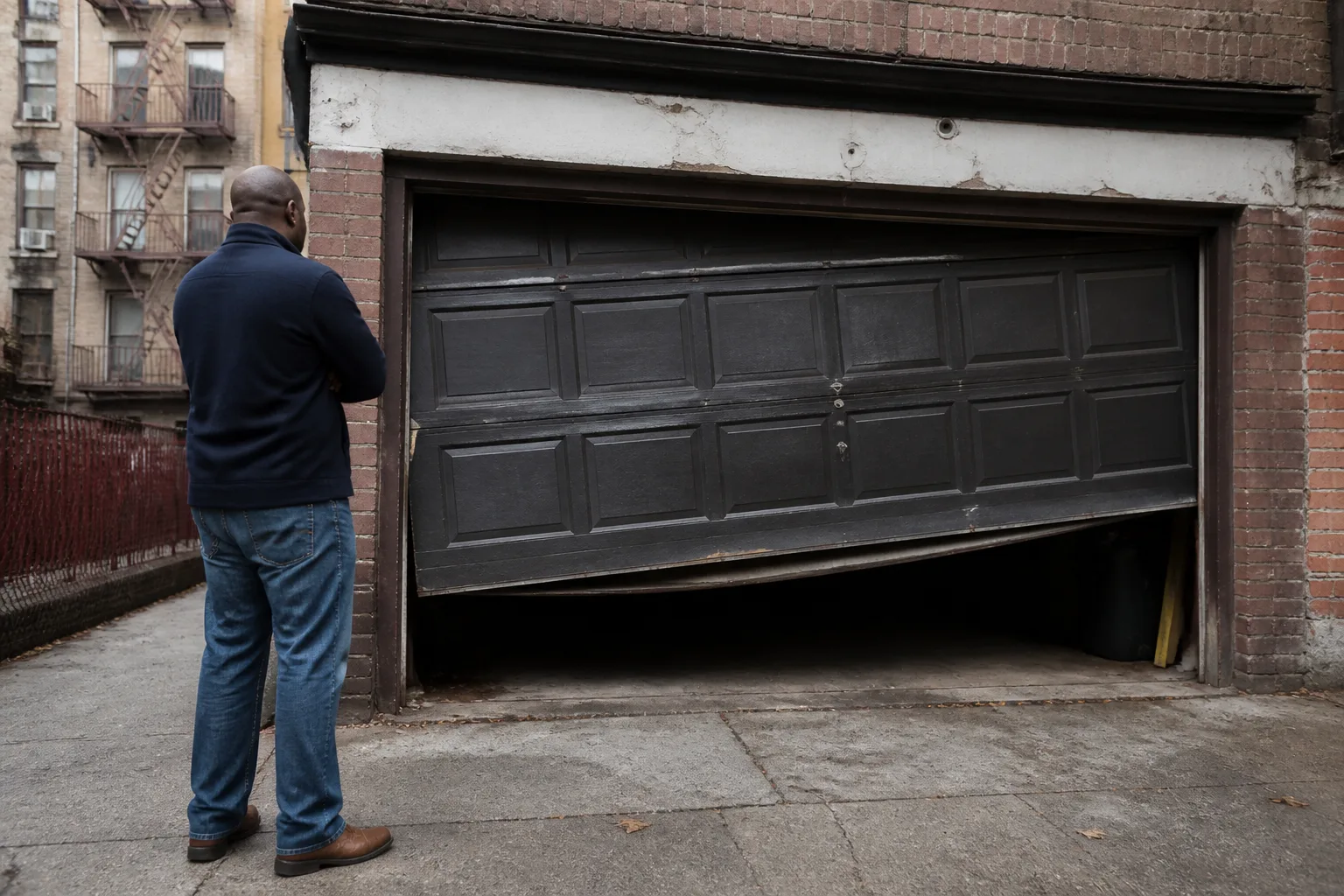
There’s a second, faster check that takes ten seconds: look at the torsion spring mounted on the shaft above the door. A healthy torsion spring is one continuous coil. A visible gap anywhere along its length means the spring has snapped – the door may still open if you have two springs and only one failed, but it’s running on borrowed tension. Extension springs mounted along the sides are a different animal: check for stretched coils, visible gaps between windings, and any sign of fraying at the ends.
Our technicians have up to 13 years of experience reading exactly these symptoms, and springs are the repair we’re built for. Call (877) 829-5867 for a free estimate before that borrowed tension runs out.
What is my door trying to tell me with that noise?
Every sound points to a different repair. Listening carefully can save you from paying for the wrong fix, and it’s the difference between a quick adjustment and a full component replacement.
- Grinding – usually a gear or drive issue in the opener itself. A stripped gear in a chain or screw drive, or a worn belt, produces a low grinding rumble. This is opener territory, not door territory, and it’s exactly the kind of failure that garage door opener repair handles.
- Popping or banging – spring or cable tension. A single loud pop often means a spring has just snapped or a cable has jumped its drum. Repeated smaller pops during travel point to a spring under uneven load.
- Scraping – track alignment. If a roller is riding hard against the side of the track, you’ll hear metal-on-metal scraping as the door travels. Left alone, misaligned tracks chew through rollers fast.
- Rattling – loose hardware. Hinge screws, roller brackets, and the opener’s mounting bolts work themselves loose over time. A rattle is usually the cheapest fix on this list, but it’s also the easiest to ignore until a bracket fails.
If the noise is accompanied by a jerking or uneven door, don’t run it repeatedly to “see if it stops.” A door that’s off-balance under load can come off its track entirely. Call (877) 829-5867 for a free estimate instead.
What visual checks can I do in ten minutes?
Grab a flashlight and walk the door from one side to the other. In Harlem, where most garage doors face the street and see constant weather, these four checks catch the majority of developing problems before they become emergencies:
- Cables – look for fraying, kinks, or rust along the length of each cable, and check that both are seated evenly on the drums. A frayed cable can fail suddenly. Don’t touch a cable under tension; if it looks compromised, call us.
- Spring gap – as covered above, a gap in a torsion spring means it’s snapped. Check both springs if you have a pair.
- Rollers – worn rollers develop flat spots, wobble in the track, or lose their nylon coating and expose the steel core. A rough, chipped roller will eventually seize.
- Weatherstripping – the rubber seal along the bottom of the door. If it’s cracked, torn, or leaving daylight visible under the closed door, you’re losing weather protection and letting debris in that can jam the bottom bracket.
Any one of these flags is worth a look from a technician. Two or more, and it’s time to stop running the door.
The cost escalation timeline: what happens if you wait?
Here’s the part most homeowners never see. Ignoring a minor issue doesn’t reset the problem – it compounds it, and the compounding is mechanical, not abstract.
- Minor adjustment today (~$150) – a track realignment, roller swap, or limit re-set. Quick, cheap, done.
- 30 days later – the misalignment has worn through two or three rollers. Now you’re paying for a track adjustment plus a roller replacement, and the opener has been straining every cycle.
- 60 days later – a failing roller or uneven tension has cooked an opener gear. Now you’re into opener replacement territory on top of the door repairs.
- 90 days later – the imbalance has overworked the spring or a cable, and you’re replacing those. A spring replacement costs several times what the original adjustment would have.
Notice the pattern: waiting doesn’t delay the cost, it multiplies it. And every one of those later-stage repairs involves more risk – a snapped spring or failed cable can damage the door panel, the opener, or worse, whatever’s underneath the door when it drops. Diagnosis first, then options. We’ll tell you what’s failing, what it costs to fix, and what happens if you don’t. Call (877) 829-5867 for a free estimate.
When should you call a pro instead of tightening a bolt yourself?
Some fixes are genuinely safe for a reasonably handy homeowner: tightening a rattling bracket, cleaning the tracks, or replacing weatherstripping. The rest deserve a technician, and it comes down to one rule – anything involving springs, cables, or the door leaving its track is beyond a DIY job.
Torsion and extension springs are under enormous tension, and a snapped spring can cause serious injury to anyone in the way. Cables carry that same load. An off-track or unhinged door weighs hundreds of pounds and can come down without warning. Don’t attempt to manually force a door back on track, don’t try to re-wind a spring, and don’t cut a frayed cable. That’s a safety line, not a shyness one.
If you’re in Harlem and any of these signs triggered a red flag, call (877) 829-5867. We work on LiftMaster, Chamberlain, Genie, Clopay, Amarr, Wayne Dalton, Craftsman, and Raynor equipment – so we arrive familiar with your exact hardware. We answer 24/7, with fast dispatch from 7am to 7pm, Sunday through Friday. A call outside dispatch hours is booked into the next opening.
Related services in Harlem
Whether you need a repair, a full replace- ment, or opener attention, one call covers it. Our garage door repair handles adjustment and off-track issues, while garage door installation covers complete replacements when the diagnosis points to a new door instead of a fix.
What happens when you call
- 1
A real person answersNo phone trees – you reach a local pro.
- 2
You get an upfront price rangeHonest numbers before anyone is dispatched.
- 3
A background-checked tech heads outLicensed & insured, dispatched right away.
- 4
You approve before work beginsNothing starts until you say go.
The Bottom Line
The warning signs are loud, slow, and uneven – and they rarely fix themselves. If your door is slower, noisier, or less balanced than it was six months ago, that’s not personality. It’s the mechanic telling you the springs or hardware have changed. Catch it early and you’re looking at a minor adjustment. Catch it late and you’re replacing springs, cables, and possibly an opener.
If you’re in Harlem and need help, Garage Door Repair Harlem offers free estimates – call (877) 829-5867. We answer 24/7, with fast dispatch from 7am to 7pm, Sunday through Friday.
Frequently Asked Questions
A broken torsion spring shows a visible gap between the coil sections, and the door often feels extremely heavy or drops quickly on a manual lift test. If you find a gap or a door that won’t stay up at waist height, stop using the door and call (877) 829-5867 for a free estimate. Springs are dangerous to inspect closely or touch under tension – call a professional.
A slow door is a real problem when the slowdown is new. Gradual speed loss usually points to weakening spring tension or opener strain, and it’s the most common warning sign we see ignored. A door that ran in 11 seconds and now takes 16 needs a look. Call (877) 829-5867 for an exact quote – estimates are free.
Yes, in most cases. A minor adjustment left alone causes the opener and components to overwork, which can turn a cheap fix into a multi-part replacement within weeks. The written estimate sets the final price. Call (877) 829-5867 for a free estimate and a diagnosis before the problem compounds.
The local professionals we connect you with are licensed and insured as their state requires. Our technicians have up to 13 years of experience and are familiar with LiftMaster, Chamberlain, Genie, Clopay, Amarr, Wayne Dalton, Craftsman, and Raynor equipment. Call (877) 829-5867 for an exact quote.
Yes, same-day and emergency availability is a core part of what we do. Call (877) 829-5867 – we answer 24/7, with fast dispatch from 7am to 7pm, Sunday through Friday. A call outside dispatch hours is booked into the next opening.
Written by the team at Garage Door Repair Harlem.
Need Garage Door Help?
Call Garage Door Repair Harlem - the local pro we connect you with is licensed and insured, here with fast help in Harlem.
(877) 829-5867